Large FTTx programs rarely belong to one engineering team. Network operators may work with design studios, construction contractors, survey teams, and existing resource systems, while each participant contributes different data at different stages. From Whale Cloud’s perspective, this makes multi-vendor coordination a core requirement for fiber network management software, not merely a project administration issue.
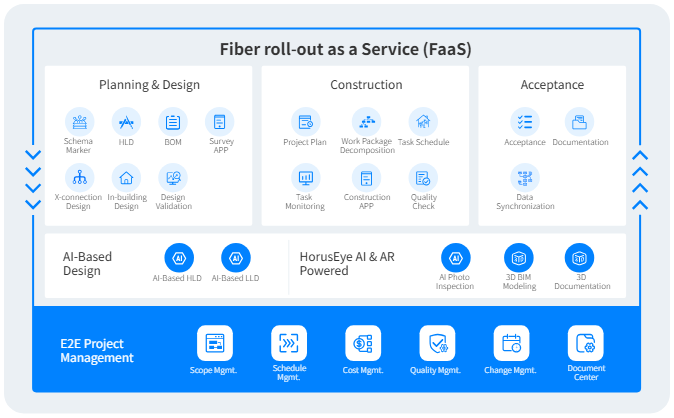
The company’s Fiber roll-out as a Service FaaS addresses planning, design, construction, and onboarding within one digital environment. The platform connects telecom operators, contractors, and design studios while providing GIS, an API gateway, workflow capabilities, dashboards, import and export tools, mobile functions, and embedded AI.
One Project Can Contain Several Versions of the Network
The coordination problem begins when each organization works from different information. Whale Cloud’s FTTx material notes that operators often use geographic tools, conventional CAD, ERP, and project management systems, leaving functions distributed across multiple platforms without sufficient coordination.
The same material identifies seamless transfer and sharing of basic FTTx data among operators, contractors, design organizations, and departments as a significant challenge. For fiber planning and design, this means consistency matters as much as drawing speed.
A Shared Workflow Becomes the Coordination Layer
FaaS organizes activities around planning, design, construction, and onboarding rather than leaving each supplier with a separate project chain. The platform covers high level design, survey, inside design, project planning, task scheduling, permits, construction, acceptance, documentation, engineering settlement, and synchronization.
This gives fiber network management software a role in coordinating activities across organizations. Instead of relying entirely on emails, spreadsheets, and exported drawings, project participants can work around defined tasks and shared project data. Vendor responsibilities remain separate, but the information needed to coordinate them can move through a common workflow.
AI Can Standardize the Engineering Starting Point
Multi-vendor projects can become difficult when design teams apply inconsistent assumptions. FaaS incorporates AI and advanced algorithms into network planning and design, including network architecture and material configuration. The official material also describes automated design checking and optimization suggestions.
For fiber planning and design, embedded AI can therefore support a more repeatable engineering baseline. It does not remove professional review. Design studios and operator engineers still need to validate geography, rules, materials, costs, and field feasibility before construction.
The company reports a 60 percent reduction in overall design time compared with traditional methods in its FaaS material. That figure should be understood as a vendor reported outcome rather than a guaranteed result for every deployment because actual performance depends on data quality, project scope, and implementation conditions.
Field Teams Must Be Part of the Information Loop
Coordination often weakens when an approved design reaches contractors. Field conditions may require changes that were not visible during desktop planning. If those adjustments remain inside local contractor records, the operator’s design and inventory can quickly diverge from the network being built.
FaaS addresses this with a mobile application that receives design information for targeted surveys and a field construction workflow that guides standard activities while enabling real time progress feedback.
This makes fiber network management software useful as a two way coordination mechanism. Engineering data moves toward the field, while survey results, construction progress, and approved changes can move back toward project management and network records.
Multi–Vendor Coordination Also Requires Project Transparency
When several contractors work simultaneously, an operator needs visibility beyond individual work packages. FaaS provides end to end project progress views and includes task and workforce automation, resource management, and early warning functions for schedule delay, cost overruns, manpower shortages, and other project risks.
That does not mean software resolves contractual or operational disagreements automatically. It does provide a shared source of project status that can make coordination more evidence based. Operators can examine progress and exceptions without depending entirely on separate contractor trackers.
Vendor Boundaries Continue After Construction
The final coordination challenge appears when newly constructed resources enter operational inventory. Different vendors may have completed surveys, designs, civil works, installation, or acceptance, but the operator eventually needs one dependable network record.
Whale Cloud’s FaaS material states that the platform combines resource, engineering, and construction data to provide a single trusted network view. It also integrates with third party resource systems to synchronize data from onboarding into inventory.
This is particularly important for fiber planning and design because future expansion depends on knowing what was actually constructed. A design environment becomes more valuable when completed project information can continue into the network lifecycle.
Coordination Should Be Measured Through Handoffs
For a multi-vendor rollout, the company would not assess performance only through design output. Useful measures include time spent exchanging project data, unresolved design versions, survey turnaround, contractor reporting delays, field changes awaiting approval, and discrepancies between construction records and inventory.
Whale Cloud positions FaaS as an integrated platform spanning the FTTx lifecycle. Its combination of workflow management, GIS, APIs, mobile tools, automated design, AI, project monitoring, and third party resource synchronization reflects the practical reality that network rollout depends on many organizations acting on consistent information.
For operators evaluating fiber network management software, the key question is therefore not whether every vendor uses identical tools. It is whether information can move reliably across their boundaries. Advanced fiber planning and design becomes a coordination asset when designs, surveys, construction activity, and final resource data remain connected throughout the rollout.