A mountain bike ride rarely keeps the body in one position for long. A rider may sit through a steady climb, stand over a rough section, move backward on a descent, and shift weight again when the trail turns technical. Those constant movements put very different demands on cycling clothing compared with a mostly seated road ride.
That is why construction details deserve attention when choosing mountain bike bibs. Seamless technology is often discussed as a way to make garments feel smoother against the skin, but the bigger idea is really about managing seams, edges, and fabric movement. A comfortable pair should stay reasonably stable without making the rider constantly aware of the clothing.
What Seamless Construction Actually Means
The word “seamless” can create the impression that a garment contains no stitching, but that is rarely the practical meaning in technical cycling apparel. Bib shorts still need seams to connect panels and secure the chamois. What matters is how those seams are positioned and finished, especially around areas exposed to repeated movement.
On a mountain bike, the hips and thighs move differently from one moment to the next. During a seated climb, the legs repeat a relatively consistent pedaling motion. When the rider stands, the hips rise away from the saddle and the shorts stretch differently. During a descent, the rider may move backward and lower the body. Every transition creates small changes in fabric tension.
A bulky seam or rough edge can become more noticeable as these movements repeat. A smoother construction can help reduce unnecessary contact and make the clothing feel less intrusive. The benefit may not be dramatic during a short ride, but small sources of irritation can become much more obvious after several hours.
Chamois Position Matters As Much As Thickness
A thick chamois is not automatically a comfortable chamois. For mountain riding, the pad also needs to remain stable when the rider repeatedly changes position.
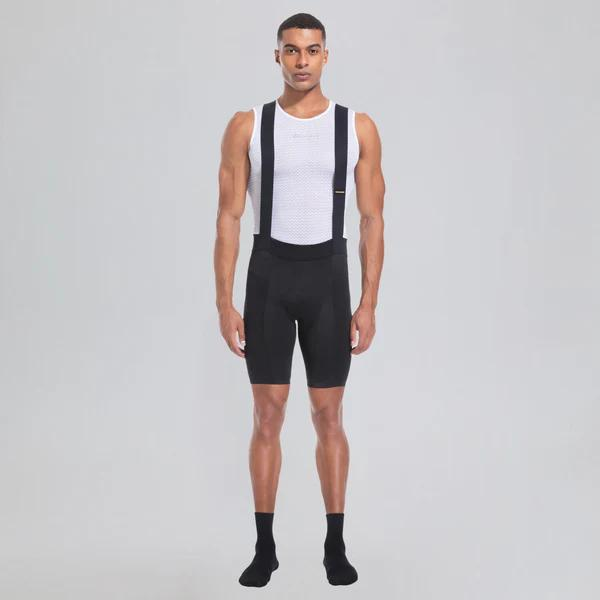
The Men’s MTB Racing Bib Shorts from Przewalski use a dual-foam chamois with 120 kg/m³ and 30 kg/m³ foam densities. The product information also specifies a three-layer mesh surface intended to improve airflow and reduce heat buildup. These features are designed around mountain and gravel riding, where seated pedaling, standing efforts, climbs, and descents can all occur within the same ride.
The attachment of the pad is another important consideration. Even good cushioning can become uncomfortable if it shifts from its intended position. When the chamois stays aligned with the main contact areas, the rider is less likely to notice folds or edges pressing against the skin.
This is where thoughtful seam management becomes useful. Instead of simply adding more padding, manufacturers can focus on how the pad connects with the surrounding fabric and how that connection behaves when the rider moves.
Fabric Movement Changes The Feel Of A Bib Short
Seams are only one part of the comfort equation. The fabric itself needs enough stretch to follow the rider without becoming loose or restrictive.
The Men’s MTB Racing Bib Shorts use a four-way stretch fabric made from 72% nylon and 28% elastane. The design is intended to accommodate climbing, descending, and technical trail movement. The product also includes side panels intended to provide additional resistance against abrasion from outdoor riding conditions.
When a rider stands, the shorts need to move with the thighs. When the body shifts backward, the fabric has to accommodate that change without pulling excessively around the waist or legs. Leg stability plays a similar role: the model uses 5 cm anti-slip leg openings to help reduce ride-up during pedaling, standing, and descending.
How To Judge MTB Bibs For Real Trail Riding
When comparing MTB bibs, it helps to look at the complete construction rather than focusing on a single feature. Chamois density, fabric stretch, seam placement, leg stability, and moisture management all affect how the garment behaves over distance.
Your own riding style should also influence the decision. Someone spending most of the day on wide gravel roads may have different priorities from a rider tackling technical singletrack. If the route involves frequent standing and body movement, stable straps and leg openings become especially useful.
Storage and moisture control add practical value for off-road riding. The Men’s MTB Racing Bib Shorts include two covered side pockets for essential items like a phone or gels. Additionally, the fabric features moisture absorption of at least 200% and quick-dry performance of at least 0.25 g/h, helping manage sweat during sustained efforts.
Seamless Technology Should Serve The Rider
Przewalski Cycling approaches its MTB bib range with that practical balance in mind. Its Men’s MTB Racing Bib Shorts combine a mountain-bike-oriented fit with a dual-density chamois, four-way stretch fabric, anti-slip leg openings, breathable construction, abrasion-resistant details, and covered side pockets. These features address several of the everyday problems that can become noticeable during longer off-road rides.
Seamless technology should therefore be viewed as part of a broader approach to garment construction rather than a feature that works in isolation. Smooth transitions can help reduce unnecessary friction, but the result depends on how the chamois, fabric, straps, and leg openings work together.
For everyday mountain bikers, that is probably the most useful way to look at technical clothing. The best construction is not necessarily the one with the longest list of features. It is the one designed to remain comfortable as the trail gets rough and the ride gets longer, without requiring frequent adjustments.