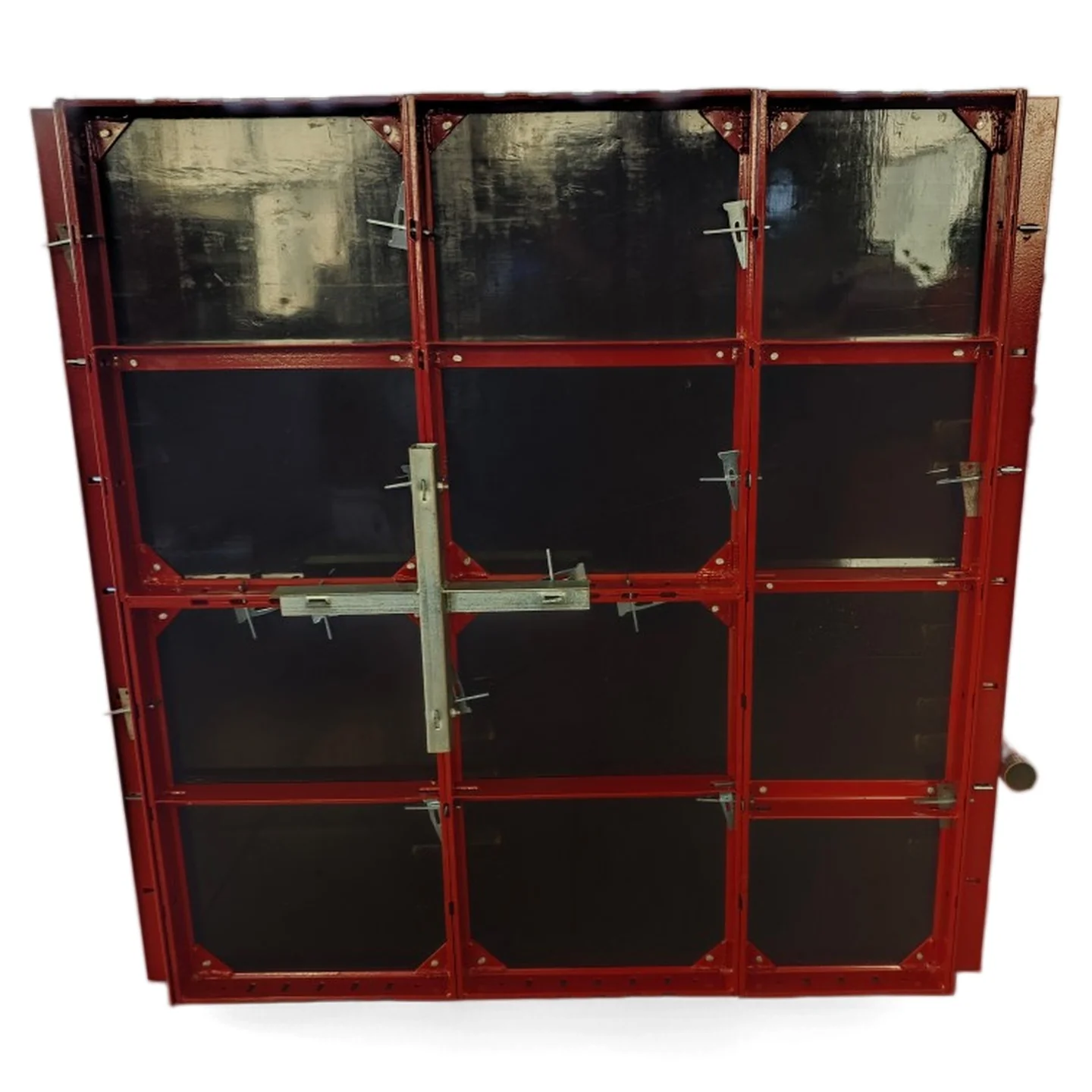
Structural integrity in modern commercial developments relies fundamentally on precise concrete placement methods. High-rise shear walls, heavy infrastructure abutments, and deep foundation basements require temporary containment systems that withstand intense hydrostatic pressure without shifting out of alignment. Utilizing robust steel ply concrete forms provides site engineers with a reliable balance between structural rigidity and manual handling efficiency during demanding pours. When general contractors evaluate forming inventory for large-scale operations, selecting systems backed by technical suppliers like Rongze helps align field execution with rigorous dimensional tolerances and safety standards.
Hybrid Structural Composition and Mechanical Properties
Combining the tensile strength of perimeter steel tubing with the smooth surface properties of film-faced plywood creates a highly resilient forming interface. The outer steel boundary absorbs intense lateral pressures exerted by fluid concrete, preventing frame warping and edge damage during high-rate placements. Meanwhile, high-density plywood inserts present a non-stick contact face that yields uniform concrete surfaces while minimizing joint leakage along panel perimeters.
Manufactured with high-strength steel and premium plywood, our formwork system ensures stable support during concrete pouring while delivering smooth concrete finishing results. The steel frame enhances structural strength and durability, while the plywood surface allows easy replacement and maintenance, reducing overall project costs. Replacing worn wood facings within the permanent metal frame allows contractors to maintain high surface quality over dozens of reuse cycles without purchasing entirely new panel units.
Lateral Pressure Resistance and Dimensional Accuracy
Continuous concrete pours in deep foundations and tall commercial columns generate substantial fluid pressure near lower panel zones. Traditional timber formwork systems often bow or deflect under these forces, producing uneven wall thicknesses that require expensive post-pour grinding. Installing high-strength steel-framed plywood formwork limits structural deflection, preserving exact wall dimensions even under rapid pour rates.
Rigid perimeter channels hold tie rods in precise alignment, distributing lateral forces evenly across adjacent panels to maintain a straight concrete face. The Steel Wood Formwork System is a practical and efficient construction solution designed for reinforced concrete casting applications. Combining robust steel frames with durable plywood panels, the system offers excellent load-bearing performance, dimensional accuracy, and repeated usability on construction sites. These combined mechanical properties allow civil engineers to meet strict building tolerances across complex infrastructure pours.
Modular Assembly Mechanics and Labor Efficiency
Minimizing floor-to-floor cycle times requires forming systems that assemble rapidly using intuitive, standardized connection hardware. Hand-set modular panels allow site crews to join adjacent frames quickly with basic wedge pins or alignment clamps, bypassing time-consuming custom timber fabrication. The modular design enables quick assembly and dismantling, improving work efficiency and minimizing labor requirements.
Streamlined stripping sequences further accelerate construction schedules by enabling workers to move panels directly to subsequent floor levels without heavy crane assistance. Standardized panel geometry reduces assembly mistakes, allowing site supervisors to verify tie placement and joint alignment swiftly before authorizing pour sequences. Accelerating formwork handling speeds up overall structural timelines while maintaining consistent safety parameters across every level.
Site Versatility Across Varied Structural Elements
Commercial infrastructure developments feature diverse structural components, ranging from narrow support columns to expansive retainment walls and thick floor slabs. Mismatched forming inventory slows down site logistics, as workers struggle to adapt specialized panels to changing architectural layouts. Utilizing flexible steel ply concrete forms resolves these spatial bottlenecks by offering interchangeable panel modules that adjust to various wall thicknesses and height requirements.
Different panel sizes and customized configurations are available to meet various construction needs, including walls, columns, beams, slabs, and foundation works. Standardized corner connectors enable smooth transitions between perpendicular walls and T-junctions without requiring custom timber fill-ins. Utilizing unified panel inventories across different structural trades simplifies yard storage, material tracking, and field transport throughout multi-phase projects.
Environmental Resilience and Corrosion Resistance
Exposing steel-framed forming equipment to moisture, chemical release agents, and alkaline concrete slurry presents ongoing corrosion risks. Unprotected perimeter frames develop rust along weld seams, causing structural wall thinning and frame deformation over extended site use. Applying a hot-dip galvanized finish coats the outer steel frame with a protective zinc barrier that shields both internal and external surfaces from aggressive jobsite chemicals.
Protective zinc layers prevent corrosion from creeping beneath the frame border, preserving nominal frame dimensions through severe atmospheric exposure. Shielding the metal framework against rust accumulation extends component service life across coastal, underground, and industrial project environments. Utilizing galvanized steel-framed plywood formwork units minimizes long-term repair costs while maintaining high load resistance across demanding deployment lifecycles.
Asset Lifecycle Management and Project Economics
Evaluating long-term capital expenditure in concrete equipment involves looking beyond initial purchase price to consider total cost per pour cycle. All-timber setups deteriorate rapidly after a few deployments, suffering from edge splitting, moisture absorption, and frame distortion. Investing in durable steel ply concrete forms extends inventory service life significantly, as the protective metal rim shields plywood edges against impact damage during stripping and site transit.
Routine maintenance becomes far more cost-effective when crews can replace individual plywood sheets directly inside undamaged steel frames. Protecting internal wood fibers from moisture infiltration maintains lightweight handling parameters, keeping manual productivity high over long project durations. High component durability lowers total material waste and reduces long-term equipment replacement costs for global civil contractors.
Structural Performance Summary
Achieving high dimensional accuracy and efficient project delivery in concrete construction requires forming systems engineered for structural stability and repeated use. Combining rigid steel perimeter frames with renewable plywood surfaces delivers optimal load-bearing capacity while protecting panel edges against jobsite wear. Modular connection mechanics accelerate setting and stripping cycles, lowering labor demands across complex commercial and civil engineering builds. Procuring engineered forming inventory supported by experienced manufacturing partners like Rongze equips construction managers with dependable structural performance, flexible site application, and long-term asset value.