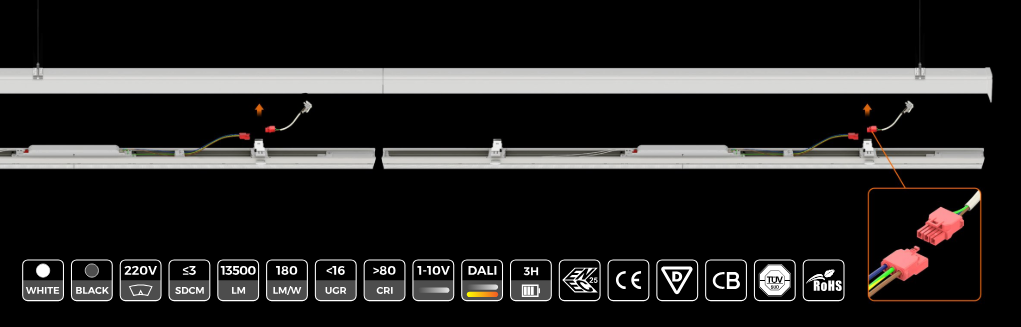
Lighting systems in industrial facilities, warehouses, and retail buildings are expected to deliver reliable illumination while keeping operating disruption under control. For aging trunking installations, replacing an entire system is not always necessary. A modular approach can preserve usable infrastructure while upgrading the light source and other performance-critical components. This makes lighting refurbishment an increasingly practical strategy for facility owners seeking better efficiency, easier maintenance, and longer system usability.
Why Replaceable LED Modules Matter
Traditional luminaires can create a maintenance challenge when a single internal component fails. If the LED source, driver, or another critical part cannot be replaced independently, the complete fixture may need to be removed. The U.S. Department of Energy has noted that modular luminaire designs can allow only the failed component to be replaced, potentially reducing life-cycle costs and protecting against technological obsolescence.
This principle is particularly relevant to LED module lights. Rather than treating the luminaire as one disposable unit, a modular design separates important functions into serviceable elements. Facility teams can therefore consider component-level replacement when maintenance is required, instead of automatically replacing an otherwise usable lighting structure.
Lower Disruption During Lighting Refurbishment
For operational facilities, installation time can be just as important as equipment cost. Warehouses, factories, and retail stores may have production schedules, inventory movements, or customer traffic that make extensive electrical work difficult. Retaining suitable existing infrastructure can reduce the amount of physical intervention required.
DOE retrofit guidance notes that retrofit kits can retain existing fixture housings, avoiding the additional work involved in removing and installing complete luminaires. The agency also highlights installation labor as an important part of retrofit economics. This makes lighting refurbishment attractive where existing trunking remains structurally and electrically suitable.
Compatibility Should Be a Purchasing Priority
Modularity only delivers practical value when replacement components are compatible with the existing installation. Buyers should therefore examine trunking type, power connection, module dimensions, electrical characteristics, optical requirements, and control compatibility before selecting replacement products.
TRIECO’s DREAMFIT is designed specifically for LED trunking retrofit and system renewal where the existing trunking circuit can be reused. Its power pick-up flying plugs are designed to work with more than 30 types of mainstream European trunking rails. The system fits up to 90% of power pick-up points on the market, helping simplify connections without structural modifications, trunking replacement, or rewiring.
Improve Maintenance Without Replacing Everything
A modular lighting strategy can make maintenance more targeted. When a replaceable component reaches the end of its useful service life, the maintenance team can focus on the affected part rather than treating the entire luminaire as waste. This approach can also help facility operators manage spare parts more systematically across large installations.
LED performance itself should still be evaluated carefully. ENERGY STAR explains that LEDs generally experience lumen depreciation rather than the abrupt failure commonly associated with traditional lamps, while thermal management has a major influence on long-term performance. Therefore, buyers evaluating LED module lights should consider heat management, driver quality, expected lumen maintenance, and the serviceability of individual components.
Support Future Upgrades and System Flexibility
Replaceable components can provide flexibility as lighting requirements evolve. A facility may eventually need different optics, controls, or light output because of changes in production layouts or space usage. Modular systems can make these upgrades more manageable when the underlying infrastructure remains suitable.
TRIECO’s broader retrofit portfolio demonstrates this approach. Its DREAMFIT solution is intended for existing trunking circuits, while its DREAMUNI system addresses applications where the original circuit is unusable and uses an interlinked power connection. Both are designed around compatibility with more than 30 types of mainstream European trunking rails.
Evaluate Total Cost, Not Just Initial Price
A lower purchase price does not necessarily represent the best commercial decision. Procurement teams should compare installation labor, energy consumption, maintenance access, replacement components, expected service life, and potential future upgrades. DOE guidance similarly recommends evaluating existing luminaire condition, desired photometric performance, installation constraints, purchase costs, and ongoing economic objectives when selecting an LED upgrade path.
For large-scale lighting refurbishment, this broader calculation can reveal why a modular retrofit may be preferable to complete replacement. Retaining suitable trunking while changing the lighting modules can reduce unnecessary material removal and potentially shorten installation work. The actual business case, however, should be confirmed through site inspection and project-specific calculations.
A More Practical Path for Long-Term Lighting Renewal
Replaceable LED module lights offer facility owners a way to modernize lighting while maintaining greater control over maintenance and future upgrades. Their value is strongest when compatibility, thermal performance, optics, electrical integration, and component availability are considered together rather than evaluated separately.
For businesses assessing lighting refurbishment, TRIECO‘s DREAMFIT provides an example of a retrofit-oriented approach that focuses on plug-in compatibility with existing trunking. Its stated compatibility with 30+ European trunking rail types and up to 90% of power pick-up points can help reduce unnecessary structural changes. Ultimately, a successful retrofit should be based on the actual condition of the existing system and a clear comparison of long-term operational costs.