Advanced robotics and medical equipment require controlled motion, repeatable positioning, and reliable operation. Servo drives regulate motor performance to match commands from a machine controller, making them important components in systems that move payloads, position instruments, or coordinate several axes. Selecting a suitable drive depends on the load, motion profile, available power, feedback device, and control architecture.
A well-specified DC servo drive can support different low-voltage applications when its capabilities match the equipment design. Understanding the applications first helps engineers identify the functions and specifications that deserve attention.
- Robotic Arms and Joint Mechanisms
Robotic arms coordinate multiple joints to position tools, components, and workpieces. Each axis has different requirements for torque, acceleration, response, and feedback. The drive should regulate motor movement while communicating reliably with the robot controller.
For collaborative and compact industrial robots, engineers should evaluate load inertia, stopping behavior, joint speed, and coordination between axes. A suitable servo configuration supports the required motion profile, although mechanical stiffness, transmission design, and feedback resolution also affect final positioning performance.
- Mobile Robots and Autonomous Material Handling
Automated guided vehicles (AGVs) and autonomous mobile robots (AMRs) depend on precise control of traction motors for acceleration, turning, and stopping. Their drive requirements change with payload, wheel diameter, floor conditions, and route geometry.
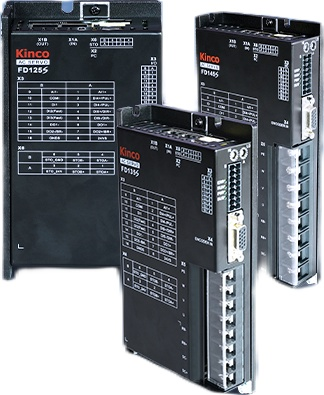
The FD1X5S low-voltage servo drive supports a 24–60 VDC supply range, making the series relevant for equipment designed around compatible low-voltage power systems. Engineers should still verify motor compatibility, current requirements, and the exact model rating before selecting a drive for mobile equipment.
- Humanoid and Legged Robots
Humanoid and quadruped robots coordinate numerous joints while responding to changing mechanical loads. Walking, balancing, and changing direction place repeated demands on acceleration, torque control, and rapid responses to feedback.
The appropriate drive architecture depends on joint torque, motor specifications, installation space, and dynamic response requirements. Compact joint modules or integrated servo solutions may also be considered for applications with strict space and weight constraints.
When evaluating a servo drive for these systems, examine peak and continuous current, supported feedback devices, thermal limits, and communication timing. The complete actuator design should also account for gearing, motor inertia, joint structure, and power consumption. Drive capability alone does not establish the robot’s movement performance.
- Gantry Systems and Coordinated Robotic Axes
Some robotic applications require multiple axes to move in a defined relationship. Gantry systems, robotic positioning platforms, and automated handling mechanisms need coordinated acceleration and position commands to maintain alignment throughout the motion cycle.
The FD1X5S series includes gantry synchronization functionality on its AS version. This feature is worth evaluating when designing compatible multi-axis equipment. Confirm the correct model suffix, supported control configuration, and synchronization requirements before incorporating it into the machine architecture.
- Medical Imaging Patient Tables
Medical imaging equipment moves patients into defined positions relative to scanning systems. Patient tables for magnetic resonance imaging (MRI) and computed tomography (CT) require controlled travel, predictable stopping, and coordination with the equipment’s operating sequence.
Servo-driven motion can support these mechanical functions when the complete design meets the equipment’s requirements. Engineers should review load capacity, travel limits, feedback, braking, mechanical stability, and emergency behavior. Medical-device validation and regulatory requirements should be evaluated at the finished-system level rather than inferred from an individual drive’s specifications.
- Compact Medical Equipment
Smaller medical systems often have strict constraints on installation space, available power, movement range, and operating noise. Their motion mechanisms can include adjustable platforms, positioning assemblies, or other controlled axes, depending on the equipment design.
A suitable drive should fit the electrical architecture and provide adequate control without exceeding thermal or current limits. Suitability for a specific device still requires engineering assessment, including electromagnetic compatibility, electrical safety, and applicable medical standards.
- Automated Inspection and Laboratory Mechanisms
Laboratory automation and inspection equipment often move samples, sensors, or test components between defined locations. Repeatable movement helps maintain consistent test procedures and coordinate mechanical actions with data acquisition.
Servo drives can regulate these positioning axes when the application requires controlled speed or position. Selection should account for payload variation, backlash, movement frequency, and cleaning or environmental conditions. Manufacturers should also verify that the selected components comply with the finished instrument’s safety and performance requirements.
- Separate Configurable Options from Full Customization
The term custom servo drive can refer to selecting communication options, motor compatibility, parameter settings, or other supported configurations for a specific machine. It does not necessarily mean the supplier manufactures a completely bespoke drive. Buyers should clarify exactly which parts of the system can be configured.
The FD1X5S series supports CANopen, Modbus RTU, EtherCAT, and PROFINET, depending on the selected interface configuration. Its product specifications also describe automatic motor-parameter identification, S-curve acceleration profiles, adaptive notch filtering, and two-channel Safe Torque Off (STO). Confirm the exact model and interface before ordering.
Build the Drive Around the Complete System
Choosing a drive for advanced robotics or medical equipment starts with the motion task. Load, speed, feedback, communication, safety, and environmental requirements should be assessed together. Prototype testing under representative operating conditions helps reveal integration issues before production release.
Kinco Automation supplies industrial motion-control products, including the FD1X5S low-voltage servo drive series. Its specifications provide a starting point for evaluating compatible applications, but engineers should verify each model’s ratings and options before finalizing a design. For medical systems in particular, component selection should be followed by appropriate system-level validation.