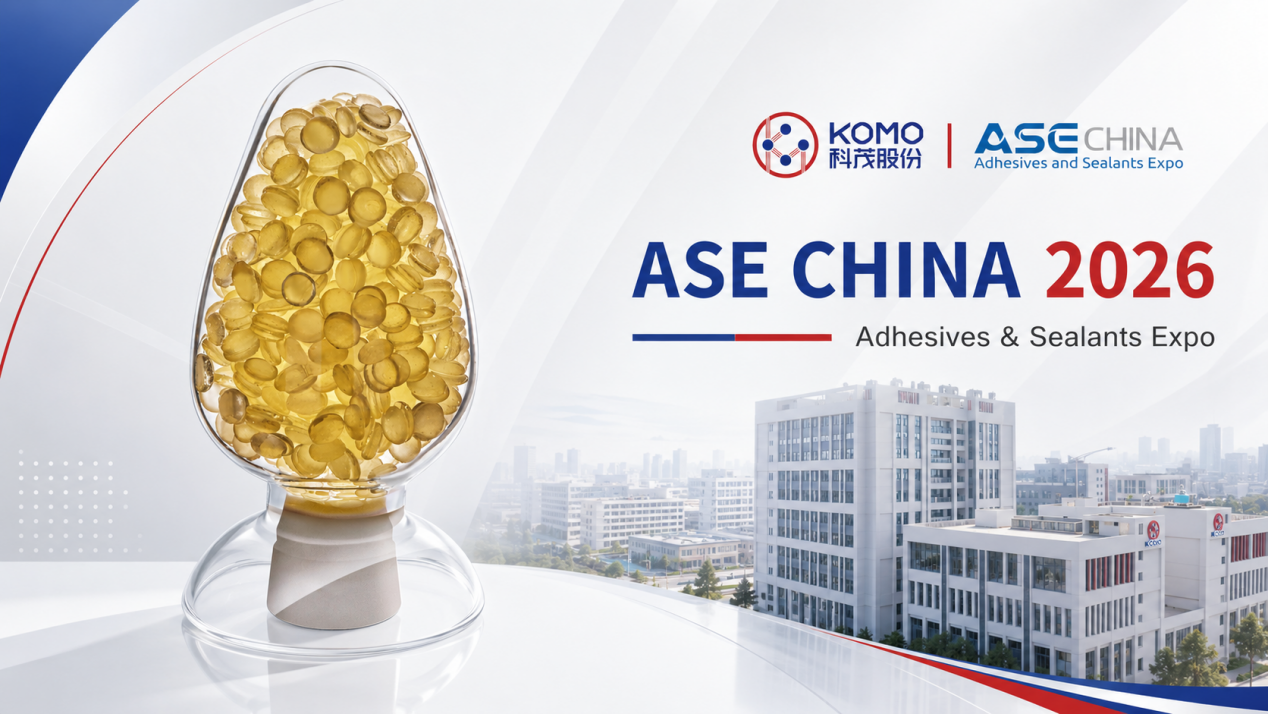
Pressure-sensitive adhesives (PSAs) are widely used in tapes, labels, packaging, and other bonding applications where immediate adhesion and long-term performance are required. Selecting the right tackifier is an important step for formulators who need to balance tack, compatibility, processing behavior, and adhesive stability. KOMO will showcase its rosin-based resin solutions at China Adhesives Expo, Booth E1562, providing opportunities to discuss PSA formulation requirements.
As a pine-chemical resin supplier, KOMO focuses on rosin-derived materials, including tackifying resins for adhesive formulations. Its product range includes rosin ester tackifiers designed for applications such as pressure-sensitive adhesives, hot-melt adhesives, and solvent-based adhesive systems.
Understanding the Role of a Tackifier for PSA Formulations
A tackifier is a functional resin ingredient added to adhesive systems to modify adhesion characteristics. In PSA formulations, it can influence initial tack, wetting behavior, compatibility with polymers, and the balance between adhesion and cohesion.
Rosin is an important natural and renewable resource. It has been chemically modified since the 1940s by utilizing active groups such as carboxyl groups and conjugated double bonds, creating a series of deep-processed products including tackifying resins used in the adhesive industry.
The selection of a tackifier depends on the adhesive polymer system and the required performance profile. Different resin chemistries can provide different levels of compatibility and interaction with elastomers or other polymers used in PSA formulations.
How Rosin Ester Tackifier Supports PSA Performance
A rosin ester tackifier is produced through the modification of rosin, creating resin materials with adjusted properties for industrial applications. These modifications allow formulators to evaluate resin options based on factors such as softening point, compatibility, color stability, and processing requirements.
Rosin ester materials have a long history in adhesive applications. Rosin deep-processing products are widely used in industries including adhesives, inks, coatings, and rubber. Rosin ester products are an important category of modified rosin materials.
For PSA manufacturers, a suitable rosin ester tackifier can help adjust the interaction between the base polymer and resin phase. This allows formulators to optimize adhesive behavior according to specific requirements, including tape applications, labels, packaging materials, and other pressure-sensitive systems.
Key Factors When Selecting Rosin Ester Tackifier
Polymer Compatibility
Compatibility between tackifier and polymer is one of the primary considerations in PSA formulation. A resin with suitable compatibility can contribute to stable adhesive performance and consistent processing characteristics.
KOMOTAC® RESIN KS2100W is a modified gum rosin polyol ester developed through processes including partial hydrogenation, esterification, and stabilization. It is described as having good aging resistance and compatibility with hot-melt, water-based, and solvent-based PSA systems.
Softening Point and Processing Requirements
Softening point is an important parameter when selecting resin materials because it affects processing temperature, flow behavior, and final adhesive properties. Different PSA applications may require different resin characteristics depending on the polymer system and production conditions.
KOMO provides multiple rosin ester tackifier options for formulators to evaluate according to application needs. Products such as KOMOTAC® RESIN KS2090W and KS2100W are categorized as rosin ester tackifiers supplied in granular form.
Stability and Application Conditions
Adhesive products may experience different environmental conditions during storage and use. Resin selection should consider factors such as heat resistance, oxidation stability, and long-term application requirements.
For example, KOMOTAC KF462S is described as a gum rosin tackifying resin with low odor, heat resistance, and oxidation resistance. It is compatible with polymer systems including NR, CR, SBR, SBS, SIS, and EVA, making it suitable for evaluation in various adhesive formulations.
Why Choose Rosin-Based Tackifiers for Sustainable Adhesive Development?
As manufacturers explore renewable raw materials, rosin-based materials continue to attract attention because they originate from pine resources. The use of natural resin derivatives provides formulators with another option when developing adhesive systems with renewable material considerations.
Rosin is both a natural product and a renewable resource, which highlights its importance in forest chemical industries and its broad application potential after processing.
For adhesive developers, rosin ester tackifiers provide a material category that combines natural-resource origin with adjustable chemical properties. Their performance must still be evaluated together with polymers, additives, and processing conditions in the complete PSA formulation.
Connect with KOMO at China Adhesives Expo
Choosing the right tackifier for PSA requires understanding both resin characteristics and application requirements. Factors such as polymer compatibility, processing conditions, and desired adhesive performance should all be considered during material selection.
At China Adhesives Expo, Booth E1562, KOMO will connect with adhesive manufacturers, formulation engineers, and raw material professionals to discuss rosin ester tackifier solutions and resin selection strategies.
Visitors can learn more about KOMO’s rosin-based resin materials and explore how tackifying resins may support different PSA formulation requirements. By working with experienced resin suppliers, manufacturers can evaluate suitable materials for developing reliable adhesive systems. With extensive experience in rosin-based resin development, KOMO supports adhesive manufacturers in evaluating suitable tackifier solutions for different PSA formulation requirements.