Selecting footwear for cycling involves different sizing logic than purchasing everyday street shoes. A precise fit ensures direct power transfer through pedal strokes while preventing numbness, hot spots, and joint misalignment over long distances. High-performance lightweight road cycling shoes require exact measurement matching to support foot stability without causing restrictive pressure.
Footwear crafted by Santic incorporates carbon fiber or composite soles paired with perforated synthetic uppers to balance power transfer and comfort. Interpreting sizing charts accurately allows cyclists to find an ideal balance of arch support, heel retention, and toe box volume.
Measuring Foot Length and Width in Millimeters
Standard shoe sizing numbers often vary across regional charts and manufacturer scales. Relying on millimeter measurements of actual foot length provides a universal baseline for cross-referencing sizing grids. Measuring feet late in the afternoon accounts for natural foot swelling that occurs during physical exertion.
Placing a foot against a wall on a sheet of paper allows for accurate tracing around the heel and longest toe. Measuring the widest point across the metatarsals reveals forefoot volume requirements. Comparing these exact metric dimensions to manufacturer charts prevents buying footwear that pinches or slips.
Accounting for Foot Swelling and Thermal Expansion
Physical exercise increases blood flow to lower extremities, causing feet to expand during extended rides. Ambient heat and intense pedaling efforts accelerate this natural volume increase. Sizing charts must be read with extra room factored in to prevent painful constriction miles into a ride.
Leaving approximately five millimeters of space in front of the longest toe allows room for foot expansion. Tight fits that feel acceptable in a cool room can transform into painful pressure points during summer training. Adequate toe box room maintains healthy blood circulation.
Evaluating Sole Stiffness and Last Geometry
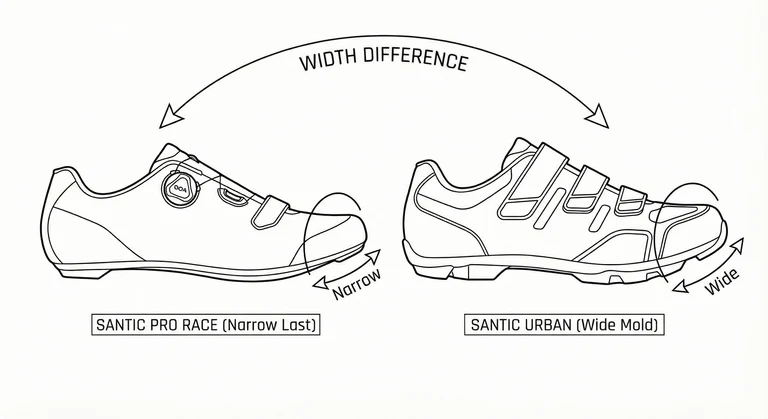
Sizing charts reflect footbed length, but the internal shape—known as the last—dictates total foot enclosure. Ultra-stiff carbon fiber soles do not stretch or yield over time like soft sneaker bases. A shoe must fit correctly from the moment it is buckled, as rigid soles offer zero break-in flex.
Different rider disciplines demand varying levels of sole stiffness and upper flex. High-performance lightweight road cycling shoes utilize rigid carbon platforms to direct leg force straight into the drivetrain. Matching foot shape to the sole profile prevents power loss caused by internal foot movement.
Understanding Arch Support and Insole Volume
Internal arch support determines how evenly rider weight distributes across the sole. A flat footbed in a rigid shoe causes arch collapse during heavy pedaling, leading to knee fatigue and arch strain. Many sizing guides offer recommendations based on arch height profiles.
Adding aftermarket insoles or utilizing built-in arch support alters internal shoe volume. High arches raise the instep, requiring looser upper closures or wider lasts. Checking instep height on sizing guides helps maintain a secure heel hold without crushing top nerves.
Heel Cup Retention and Ankle Security
Proper sizing keeps the heel locked firmly against the rear cup during upward pedal pulls. Slipping heels waste mechanical energy and cause friction blisters along the Achilles tendon. Sizing charts should guide selection toward a snug rearfoot fit that holds firm without pinching.
Footwear designed by Santic utilizes structured heel counters to stabilize the rearfoot during high-cadence pedaling. Secure heel cups prevent foot migration forward into the toe box on steep descents. Heel stability forms the foundation of smooth pedal strokes.
Differentiating Between European and US Sizing Scales
European sizing scale increments are smaller than US sizing intervals, allowing for more precise fit adjustments. Half-sizes in European sizing often alter shoe volume and width rather than just footbed length. Reviewing conversion charts carefully prevents misinterpreting size jumps.
Riders transitioning from standard sneakers often make the mistake of buying cycling shoes too large to compensate for narrow toe boxes. Looking at millimeter dimensions eliminates confusion between US, UK, and European conversions. Metric numbers remain the most reliable reference on sizing charts.
Upper Material Stretch and Closure Adjustment Range
Synthetic uppers featuring mesh venting or laser perforations wrap the foot tightly while resisting stretching over time. Unlike natural leather, modern synthetic uppers maintain their factory shape across seasons of use. Sizing choices should assume the upper material will not expand significantly with wear.
Closure mechanisms like micro-adjustable dials and straps allow fine-tuning over the instep. Selecting the correct size ensures closure dials operate near the middle of their adjustment range. Having room to tighten or loosen straps accommodates variable sock thicknesses.
Checking Cleat Placement Alignment Relative to Foot Size
Cleat mounting slots on sole bases correlate directly with shoe sizing. Proper sizing ensures the pedal spindle aligns directly beneath or slightly behind the ball of the foot. Misjudging shoe size shifts cleat positions forward or backward, increasing strain on calf muscles and Achilles tendons.
Selecting lightweight road cycling shoes in the correct size places mounting hardware in an optimal position for biomechanical alignment. Proper cleat position optimizes leg leverage and protects knee joints during high-torque efforts. Alignment accuracy depends directly on matching foot length to shoe size.
Conclusion
Interpreting cycling shoe size charts accurately requires measuring foot dimensions in millimeters, factoring in thermal swelling, and recognizing the uncompromising nature of rigid carbon soles. Proper fit preserves joint health, eliminates hot spots, and supports direct power transfer across every pedal revolution. Careful reference to sizing parameters equips riders with long-distance comfort and reliable pedaling performance on every route.