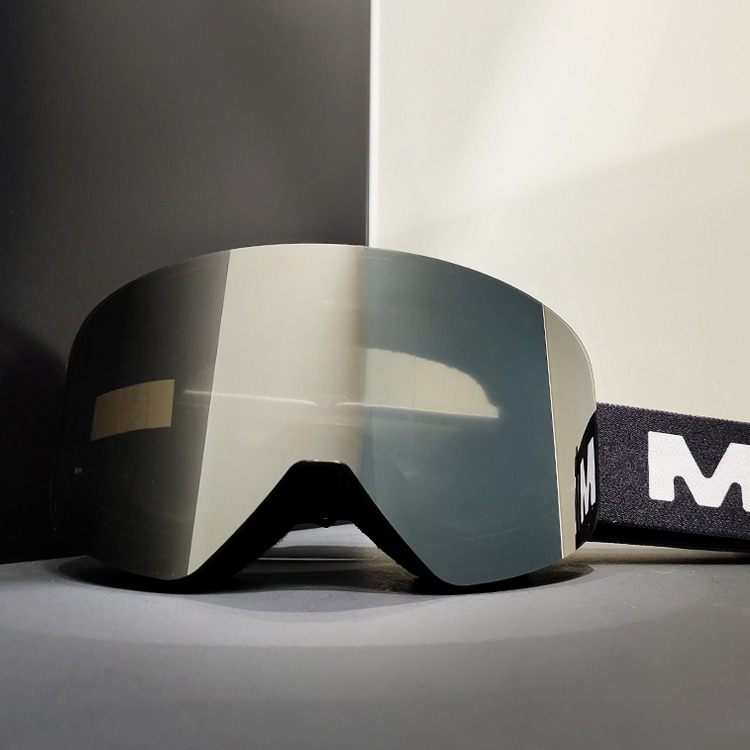
Peripheral vision is important on a ski slope because riders need to monitor terrain, other people, and changes in direction without relying on their central view alone. Frameless ski goggles can support a broader visual area by reducing the amount of visible structure surrounding the lens. Lens size, curvature, fit, and helmet integration also influence the viewing experience. It enables skiers to spot hazards rapidly appearing at the edge of their field of vision, allowing for smoother reactions when executing turns during a descent.
How Does a Frameless Design Change the Viewing Area?
In a conventional full-frame goggle, the frame surrounds the lens and forms part of the boundary visible around the rider’s line of sight. In a frameless design, the lens covers more of the goggle structure, leaving less visible frame around the viewing area. Salomon describes frameless goggles as designs in which the lens covers the goggle structure and the field of vision is increased. This construction can therefore give the wearer a less obstructed view toward the sides.
That can be useful when a skier needs to notice movement approaching from either side while maintaining a forward-facing position. Peripheral vision is not simply a matter of making the lens look larger. A goggle needs to stay properly positioned on the face, so frame geometry and fit should be assessed together.
Why Does Lens Shape Still Matter?
Lens geometry plays an important role in the final field of view. REI explains that spherical lenses curve both horizontally and vertically, while cylindrical lenses curve horizontally but remain vertically flat. Its guide notes that spherical lenses provide greater peripheral vision than cylindrical lenses, while larger lenses can also increase peripheral vision. These differences show why frameless construction is only one factor in visual coverage.
For brands comparing ski goggles suppliers, this distinction can guide product evaluation. Rather than using the label “frameless” as a complete performance description, buyers can examine the lens profile, dimensions, frame construction, and fit together. The aim is to understand how the visible lens area and the physical goggle structure interact on the face.
What Role Does Fit Play on the Mountain?
A goggle’s field of view depends on how the product sits relative to the rider’s eyes and helmet. A well-fitted model should maintain stable contact with the face while keeping the lens positioned correctly. The helmet can also affect the available viewing area if its brim or shape overlaps the upper part of the goggle. For this reason, field-of-view testing should reflect actual helmet use rather than evaluating the goggle in isolation.
Where Does YH693 Fit Into This Design Approach?
YH693 is a frameless magnetic ski goggle model referenced in YIJIA Optical’s online content. The relevant point here is the frameless concept: reducing the visible frame around the lens can give peripheral coverage greater design emphasis.
The magnetic element serves a separate function from the frameless structure. Magnetic lens systems are generally designed around lens interchangeability, allowing a goggle platform to accommodate different lens configurations. For brands developing magnetic ski goggles, lens replacement, retention, and ease of handling can also shape the product experience, particularly for models intended for changing light conditions.
What Should Ski Goggles Suppliers Review Before Production?
For business-to-business (B2B) buyers, design evaluation should move from appearance to measurable construction details. Review the lens geometry, frame profile, lens retention method, face fit, ventilation arrangement, helmet compatibility, and customization requirements. These details can affect tooling, assembly, validation, and market positioning. They can also influence how efficiently a proposed design moves from sampling into repeatable production, which is an important consideration for private-label and branded winter sports programs.
YIJIA Optical, with more than 20 years in sports eyewear manufacturing, supports original equipment manufacturer (OEM) and original design manufacturer (ODM) programs from concept development through 3D design, mold making, sampling, production, assembly, and quality control.
For businesses seeking OEM ski goggles, that development range can be relevant when an existing frameless concept needs changes in branding, colors, lens systems, materials, or other structural details. YIJIA Optical states that it serves brands, distributors, and wholesalers with customized sports eyewear solutions.
How Should Peripheral Vision Claims Be Assessed?
Frameless construction can give the lens a larger visual presence and reduce the amount of frame surrounding the viewing area. However, it should be assessed as one element of the overall goggle design. Lens geometry, size, fit, and helmet interaction can all influence the actual viewing experience, so comparing these features together provides a practical basis for product selection.
For magnetic ski goggles, the same principle applies. The magnetic mechanism and frameless structure address different design objectives, and neither should be treated as a substitute for evaluating the rest of the product. For commercial buyers, documented specifications and development capabilities provide a practical foundation for comparing models and planning an eyewear range.