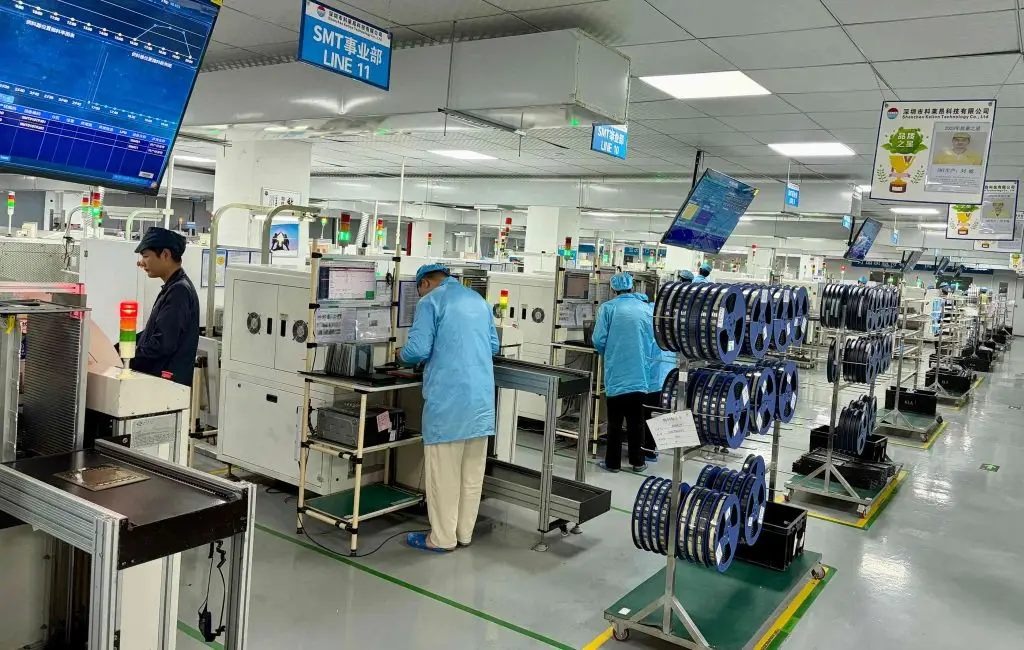
Product mass production should be managed through controlled stages: validate and freeze the design, prepare critical materials and suppliers, run trial builds, verify process stability, and scale volume only when quality data supports the next step. A product that works in a prototype build may still contain parts with unstable supply, assembly steps that depend on individual skill, test procedures that take too long, or tolerances that produce inconsistent fit. Management therefore begins before the production line ramps.
The design has to mature, critical components and suppliers have to be prepared, trial builds have to expose manufacturing variation, and quality data has to confirm that the process can repeat. The practical objective is to convert engineering intent into a documented system that can produce many units with the same defined characteristics.
Freeze the Right Design, Not Merely the Latest Prototype
A team studying how to mass produce a product first has to decide when electronic prototyping has answered the important engineering questions. Freezing too early carries unresolved defects into tooling and purchasing; freezing too late creates continuous revision that prevents stable process setup.
The release point is strongest when core function, mechanical fit, firmware behavior, interfaces, and critical performance have measurable validation rather than informal approval. Design control after release is equally important. Changes may still be necessary, but each change needs an owner, reason, affected part list, validation plan, and effective production point.
Without that discipline, factories can build mixed revisions or use a new component before firmware and mechanical compatibility are checked. Mass-production management depends on knowing exactly which product definition each batch is supposed to reproduce.
Use Trial Builds to Convert Design Risk into Process Knowledge
The next part of how to mass produce a product is learning from controlled pre-production, and electronic prototyping alone cannot fully reproduce line conditions. Before volume manufacturing, Minewing uses Engineering Validation Test (EVT), Design Validation Test (DVT), and Production Validation Test (PVT) small batches as successive checks on engineering maturity, design validation, and process readiness.
Those builds can expose problems in assembly sequence, fixture design, programming, test access, tolerances, work instructions, and operator handling that may not appear in individually built engineering samples. Minewing also supports multiple prototype rounds and design revisions so that issues can be found before scale-up.
DFM is applied to improve yield and reduce assembly cost. The management value of these stages lies in their output: trial findings need to become updated drawings, BOM controls, test specifications, tooling corrections, or process instructions. A build that identifies problems but does not close them is only an expensive observation.
Stabilize Materials and the Complete Box-Build Flow
Anyone defining how to mass produce a product also has to manage material readiness alongside electronic prototyping, because an approved design cannot run if critical parts arrive late or vary by source. Minewing manages component sourcing, procurement, and material coordination through its supplier network, with supply-chain setup that includes sourcing and validation of critical components and vendors.
Such preparation can reduce sourcing risk and make the production schedule less dependent on last-minute substitutions. The product flow continues beyond PCBA. In Minewing’s box-build flow, enclosure completion, final assembly, test readiness, and packaging become linked schedule dependencies before finished units are released for distribution.
Treating these as one flow makes dependencies visible: enclosure availability affects final assembly, firmware loading may affect test sequence, packaging can require accessory checks, and shipping dates depend on the completion of all prior stages. Mass-production planning therefore needs a schedule for the complete product, not only the circuit-board line.
Material planning also needs revision discipline. If a shortage forces a proposed alternate part, engineering validation has to confirm electrical, mechanical, firmware, and regulatory implications before purchasing treats the substitute as equivalent. That control protects the released configuration while still giving the supply chain a managed way to respond to shortages.
Ramp Volume Only When the Process Can Repeat
The final answer to how to mass produce a product is controlled scaling, with electronic prototyping replaced by process evidence as the main source of confidence. Once process stability is demonstrated, Minewing‘s ISO 9001-certified management system carries inspection, testing, and validation into scalable volume assembly, retail packaging, and worldwide shipping.
Its no-strict-MOQ model lets scale increase in stages—from single prototypes to low-volume trials and then high-volume manufacturing—after process evidence supports the next step. During ramp, managers need to watch defect patterns, yield, rework, component shortages, test failures, and any change in cycle behavior.
A successful pilot does not by itself prove that a larger build will remain stable. Feedback from production may still trigger engineering action, but the response is controlled and documented. A stable ramp is reached when materials, equipment, instructions, inspection, and logistics can support the intended output without depending on repeated emergency corrections.
Product mass production is managed through gates that turn uncertainty into controlled information. Prototype validation proves the design, NPI exposes line-level risk, DFM removes avoidable assembly difficulty, supplier preparation protects material availability, and quality data determines whether the process is ready to scale.
Minewing’s workflow connects these stages with box-build assembly, testing, packaging, and logistics so production remains a connected control system across the full ramp. Readiness for volume is determined by whether the released design, approved materials, validated process, and quality controls are mature enough for each additional unit to repeat the intended product instead of becoming another engineering experiment.
Controlled escalation paths for shortages, defects, and design changes keep that repeatability intact during the ramp. The same discipline keeps later production changes from quietly redefining the approved product.