Fast-changing current signals demand more than a sensor with a high current rating. Bandwidth determines how much of the waveform can be reproduced, while response time indicates how quickly the output reacts to a change. Fluxgate Sensors can combine DC measurement with wide frequency response through closed-loop magnetic compensation, making them useful for inverter testing, battery systems, motor drives, and precision power analysis. Hangzhi develops fluxgate current transducers with multi-point zero-flux control, giving high-precision measurement systems a way to address both steady-state accuracy and rapidly changing current behavior.
Bandwidth Is More Than a Maximum Frequency
Bandwidth describes the frequency range over which a sensor maintains its specified response. A 100 kHz specification, for instance, does not mean that every waveform component below 100 kHz will have identical amplitude and phase accuracy. The cutoff definition, attenuation, phase behavior, and test conditions should all be checked before comparing two devices.
Waveform characteristics matter just as much. A battery system may contain relatively slow current changes mixed with converter ripple, while an inverter can produce steep transitions and substantial high-frequency content. Closed-loop zero-flux architectures can extend frequency response because the compensation winding can also behave as an AC current transformer at higher frequencies.
A wider bandwidth is not automatically better in every measurement chain. Excessive high-frequency response can expose the acquisition system to switching noise, electromagnetic interference, and unwanted harmonics. The useful bandwidth is the range that captures the information required by the application without creating unnecessary measurement problems.
Response Time and Transient Accuracy in Fluxgate Sensors for Fast-Changing Currents
Response time describes how rapidly the sensor output follows a current transition. Shorter response times are valuable when a measurement system must capture steep edges, load steps, protection events, or converter switching behavior. Yet the number should be interpreted alongside bandwidth because the two specifications describe related but different aspects of dynamic performance.
A sensor can respond quickly to a transient while still introducing amplitude or phase errors at higher frequencies. Such distortion may influence calculated power, efficiency, switching losses, or control-loop behavior. In closed-loop zero-flux configurations, response time can be reduced while extending usable bandwidth, allowing AC, DC, and complex current waveforms to be measured through the same architecture.
External conditions should not be overlooked during transient testing. Cable arrangement, conductor position, nearby switching components, grounding, and the measurement instrument itself can affect the observed waveform. A realistic test setup should reproduce the final electrical environment instead of evaluating the transducer only with an ideal laboratory signal. Bandwidth and response time in fluxgate sensors for fast-changing currents should be interpreted together to assess transient accuracy.
Accuracy, Noise, and Dynamic Range
Dynamic performance has little value if the signal becomes buried in noise. High-frequency switching can introduce common-mode disturbances, magnetic interference, and voltage transients that appear alongside the current waveform. Shielding, grounding, physical separation, filtering, and appropriate signal interfaces can influence the final result as much as the sensor’s nominal bandwidth.
When evaluating Fluxgate Current Sensors, dynamic range creates another trade‑off. A system measuring several hundred amperes may also need to resolve relatively small current variations. A sensor with a very large full‑scale range should be checked for offset and resolution near the lower part of its range, particularly where small changes are important to the application.
Hangzhi’s portfolio illustrates the range of dynamic specifications available. The AIT Series provides bandwidth options of 800 kHz or 500 kHz with 10 ppm accuracy, while the IIT Series offers 100 kHz bandwidth with 0.02% accuracy and measurement ranges up to 30 kA. The DIT Series provides digital output with 0.02% accuracy across a 60–2,000 A range. These examples show why bandwidth and response time need to be evaluated alongside current range and mechanical requirements.
Practical Selection and Validation
Application requirements should define the target dynamic performance. Motor drives, EV inverters, renewable-energy converters, and power analyzers can each produce different transient profiles. A useful specification review identifies the fastest expected current change, the highest relevant harmonic frequency, the required measurement accuracy, and the minimum signal that must remain distinguishable from noise.
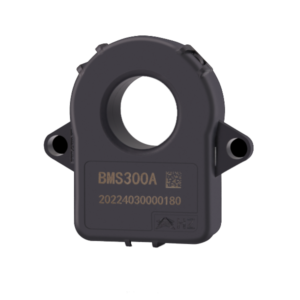
As a practical Hangzhi reference, the BMS Series automotive current transducer covers 300–1500 A, specifies 0.5% accuracy, and provides a CAN digital signal output. Its configuration demonstrates another important point: dynamic current measurement is not solely about analog bandwidth. Communication rate, signal processing, averaging, and data transmission can also influence how quickly a measured change becomes available to the wider control system.
The About Hangzhi page provides additional background on the company’s current-sensing technology and its application areas, including EV mobility, renewable energy, rail systems, and medical equipment. In each case, the appropriate dynamic specification depends on the waveform and system architecture rather than on a generic preference for the highest bandwidth available.
Conclusion
Bandwidth and response time should be judged according to the current waveform, measurement objective, and surrounding electronics. A converter-control system may prioritize rapid transient tracking, while a power analyzer could place greater emphasis on amplitude accuracy and phase behavior across a defined frequency range.
Fluxgate Current Sensors offer a useful combination of AC/DC capability, closed-loop compensation, and dynamic measurement performance when these requirements overlap. Hangzhi applies multi-point zero-flux technology to precision current and voltage transducers, while the About Hangzhi page provides further technical background. Application-specific questions can be addressed through contact us when current range, transient speed, bandwidth, interface, and environmental conditions need to be assessed together.