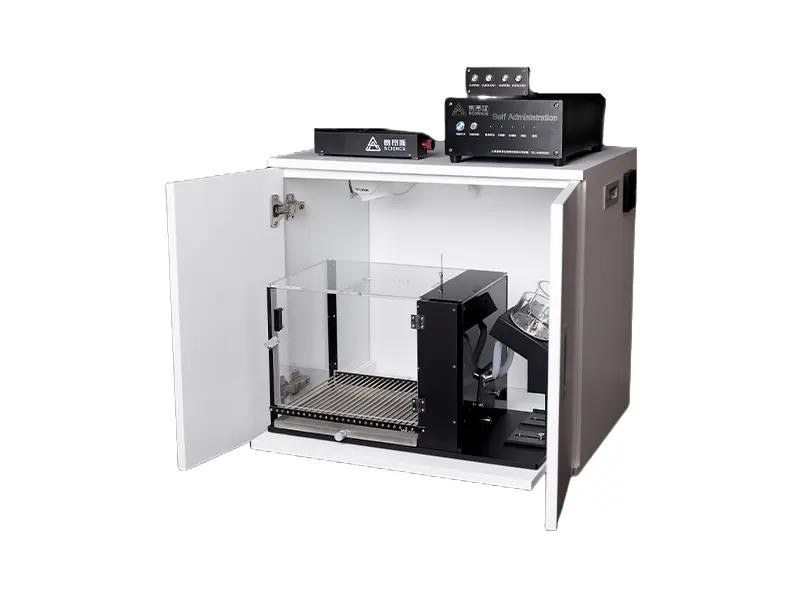
Drug seeking behavior in rodents is studied through operant tasks in which an animal performs a defined action to obtain a drug or another reward. Self-administration models connect the animal’s response with reinforcement and allow researchers to quantify behavior over repeated sessions.
The resulting data can describe response patterns, reward delivery, timing, and changes across training or later behavioral phases.
Start With the Operant Response
A basic measurement is how often the animal performs the required response. In a self-administration chamber, this may be a lever press or another operant action. Counting responses provides a basic view of how actively the animal engages with the task, but the total number alone gives limited context.
It is more informative to separate effective responses from ineffective responses, and the self-administration system records both types.
This setup allows researchers to distinguish actions that trigger a programmed outcome from responses that occur during a refractory period or otherwise do not activate the reward sequence, while left- and right-lever activity can also be recorded separately.
Track Reward-Linked Events
A second measurement layer concerns what happens after an effective response. Researchers may examine infusion times, infusion volume, reward counts, and reward status alongside the operant response. These measurements connect the animal’s actions with the programmed consequence and help organize session-level behavioral data.
For experiments using intravenous administration, the programmable syringe pump supports controlled delivery, while the software records infusion-related events.
The system lists a single-dose range of 0.001 mL to 1 mL and programmable pump speeds from 0.5 to 60 RPM. These are equipment specifications rather than universal experimental settings, so the actual parameters depend on the study design.
Compare Active and Control Responses
Drug seeking behavior is easier to characterize when the response associated with the reward can be examined alongside a control response. The setup uses left and right levers, with the effective lever linked to the programmed reward while the control lever records activity without delivering that reward.
This comparison gives researchers another layer of behavioral context. A rise in effective responses accompanied by a different pattern on the control lever can be described separately from overall chamber activity. Recording both sides also creates a more explicit dataset for comparing experimental groups or sessions.
Examine Timing, Not Just Counts
The timing of each event can add important context to response totals. Event timestamps allow researchers to examine when lever presses, infusions, and other recorded events occur within a session. Infusion timing can be considered alongside response timing to describe the sequence of behavior and reinforcement.
Repeated measurements across sessions can also reveal whether response patterns change during training. The protocol records effective, ineffective, and control lever presses together with the number of drug administrations.
Later sessions can be examined after response levels become more stable, illustrating how longitudinal measurements can be incorporated into the analysis.
Add Reward and Engagement Measures
Not all useful information comes from the lever. The self-administration system also records pellet reward counts and head-entry detection, while video monitoring can provide a record of the animal’s status during the experiment.
These measurements can add behavioral context when researchers are examining motivation, reinforcement learning, or related reward-seeking patterns.
Sound and light cues are also part of the system. Programmable house and stimulus lights, independent sound control, and cue delivery can be associated with experimental events. Recording these events alongside operant responses helps researchers relate the animal’s actions to the broader structure of the task.
Match Measurements to the Research Question
The measurement priorities depend on what the study is designed to examine. A reinforcement-focused analysis may emphasize effective responses and reward delivery. A response-specific analysis may compare active and control lever activity.
A longitudinal study may place greater attention on event timing and response changes across sessions.
The current self-administration platform is listed under the Reward & Addiction portfolio and is designed for rat and mouse studies. Its software can support up to 32 self-administration cages simultaneously, with independent signal detection in each box and wireless connections between cages and the controller.
Build a Multidimensional Behavioral Dataset
A single response count rarely captures the full structure of drug seeking behavior. Combining response type, infusion events, reward data, timing, and engagement measures creates a more detailed record that can be examined according to the experimental question. It also makes it easier to distinguish an overall increase in activity from a change specifically linked to reinforcement.
BioMed Easy’s Self-Administration system integrates the operant chamber, controller, syringe pump, drug delivery components, cues, video monitoring, and analysis software in one research setup. Product configurations are available for both rats and mice, with SA214R listed for rats and SA214M for mice.
Researchers planning a drug seeking behavior study can contact BioMed Easy to discuss the required measurements and select a configuration suited to their experimental design.