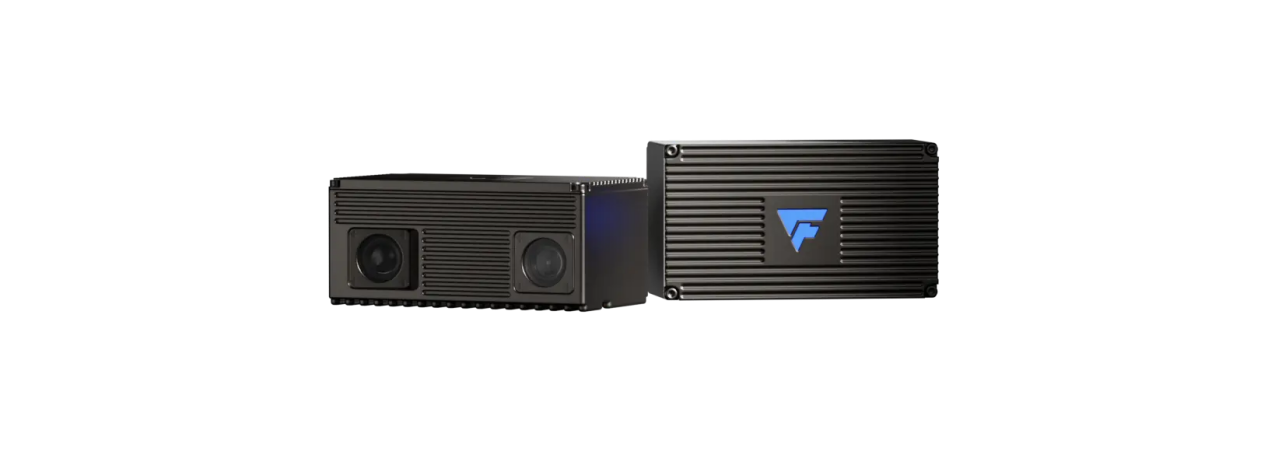
The shift toward intelligent automation demands increasingly precise, high-speed spatial awareness. Traditional 2D vision systems, while fundamental, are limited by a flat perspective, often failing to provide the depth and volume data essential for complex tasks like robotic guidance, inspection, and bin picking. This is where the structured light camera revolutionizes industrial applications, offering robust, non-contact measurement that captures the intricate geometry of physical objects. This powerful technology, core to modern 3D machine vision camera systems, operates through a fascinating yet elegantly simple process: projecting calibrated patterns and then decoding their deformation.
The Core Principle: Creating Depth with Light
At its heart, structured light technology provides a solution for determining the depth (the Z-axis) that standard 2D cameras cannot inherently measure. The core idea is to introduce a known variable—a distinct, high-contrast pattern of light—onto an object’s surface. When this pattern hits a perfectly flat surface, it remains undistorted. However, when the light strikes a three-dimensional object, the surface topography—its peaks, valleys, and curves—causes the projected pattern to bend, warp, and deform.
A structured light camera system, such as those engineered by Transfer3D, is fundamentally comprised of two key components: a projector and one or more cameras. The projector, often a Digital Light Processing (DLP) chip or a precise laser galvanometer, is responsible for projecting the highly accurate sequence of patterns. The camera then captures the appearance of this distorted pattern. The magic lies in the fact that the system knows exactly where the projector is, where the camera is, and what the original pattern looked like. Any deviation in the captured image is a direct, quantifiable indicator of depth. This method is incredibly robust, often providing high-resolution point cloud data quickly and reliably across diverse materials and challenging environments, making it ideal for the demanding world of B2B industrial automation.
The Projection Phase: Encoding the Surface
The quality of the final 3D data starts with the quality of the light pattern sequence. The most common and accurate method employed by high-end structured light camera systems is the use of fringe or grating patterns. These patterns typically consist of alternating black and white stripes (or gray levels) that are projected onto the target object in a precise, time-sequential manner.
Instead of a single image, the system projects a rapid sequence of patterns. A typical sequence involves shifting the phase of these stripes across the object several times, or projecting patterns that encode position information through binary or grayscale codes. This sequential process is critical because it allows the system to assign a unique light value (or phase) to every single pixel in the camera’s field of view, regardless of surface texture or shadows.
By using this advanced method, the system eliminates ambiguities that simpler approaches, like a single laser line, cannot overcome. For instance, if a laser line hits an object with a steep concave curve, the camera might see two points on the line, but it cannot know which parts of the original projected line correspond to those two points. By using a time-multiplexed sequence of stripes, the system effectively tags every point on the object’s surface with its precise coordinate information, ready for the next step: decoding.
From Pixels to Precision: Decoding with 3D Machine Vision Cameras
Once the object’s surface has been “encoded” by the projected patterns, the camera captures the distorted images. The decoding process begins by analyzing these images to map the captured light information back to the known, original projected pattern. This is where the mathematical foundation of stereoscopic vision—triangulation—comes into play.
Triangulation is a geometric principle that allows an unknown point to be located if its position is observed from two known, separate points. In the case of a structured light camera, the two known points are the center of the projector lens and the center of the camera lens. The baseline distance and angle between the projector and camera are precisely calibrated and fixed.
For every pixel the camera captures, the internal software compares the pixel’s coordinate and the unique phase/stripe value it captured against the known geometry of the system. The distortion of the stripe pattern tells the system exactly how much the light path has been shortened or lengthened by the object’s height. By combining the known angles and distances (baseline) with the observed angle of the light ray captured by the camera, the system calculates the three-dimensional (X, Y, Z) coordinates for that specific point on the object’s surface. Repeating this process for millions of data points captured during the sequence generates a dense and highly accurate representation of the object, known as a point cloud. This point cloud is the fundamental data used by 3D machine vision camera applications for tasks such as quality control, volume calculation, and robotic navigation.
Real-World Precision and Transfer3D Solutions
The ultimate value of this technology for B2B applications lies in its speed, accuracy, and reliability in real-world factory environments. Manufacturers require systems that can handle a variety of surfaces—from glossy metals and reflective plastics to dark, non-cooperative materials—while maintaining sub-millimeter precision.
Leading 3D vision providers like Transfer3D optimize the structured light method to meet these complex industrial demands. By leveraging proprietary software and advanced algorithms, their Epic Eye series cameras can acquire high-quality point cloud data rapidly, minimizing cycle time in automated processes. For example, the Transfer3D Epic Eye Pixel Mini camera, which utilizes structured light with LED illumination, is engineered for precise short-range tasks. This compact system offers verified factory-floor Precision of 0.1mm @ 0.5m and an Optimal Working Distance of 300-700 mm. Such precise specifications, sourced directly from the product detail page, guarantee the level of accuracy necessary for fine assembly, small parts inspection, and machine tending applications.
By mastering the science of pattern projection and decoding, Transfer3D delivers integrated solutions—combining robust hardware with proprietary vision guidance platforms—that empower global industrial manufacturing and warehousing logistics to achieve 100% quality and 100% reliability in their automated processes. Understanding how the structured light camera captures and processes depth information is the first step toward integrating this critical technology into the next generation of industrial intelligence.